In a rapidly urbanising world, where the building stock is expected to grow fast in Asia and Africa, the building sector accounts for significant global CO2 emissions. This makes the decarbonisation of buildings and the construction sector a key priority. At the same time, the resilience of buildings is becoming a pressing issue due to the increasing risks associated with climate change and natural hazards.
Lines of action and themes in SDC engagement in the low-carbon and resilient built environment
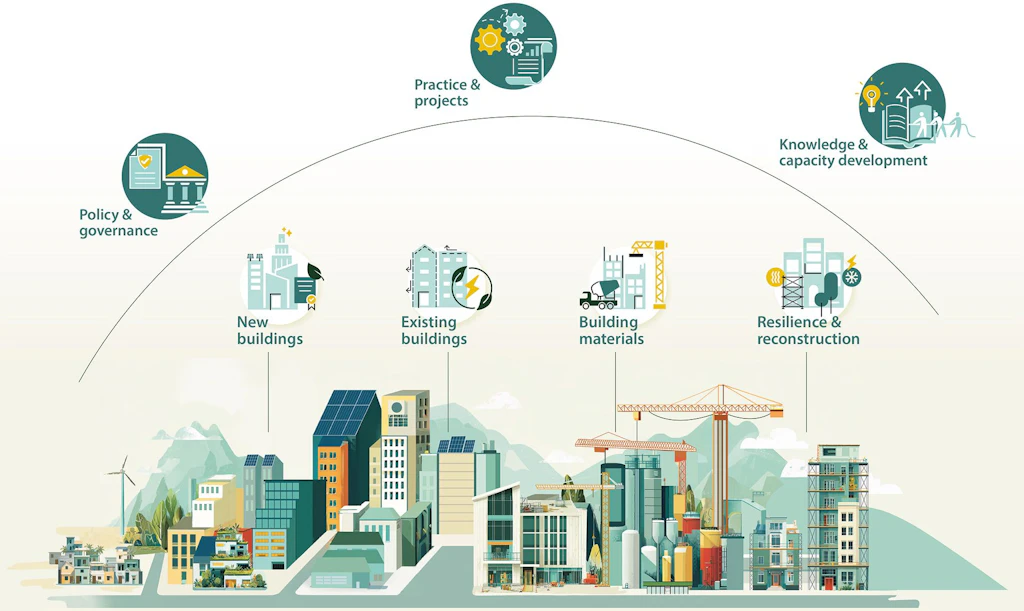
The SDC has supported a wide range of projects in the built environment, spanning the themes, new buildings, existing buildings, building materials, as well as resilience and reconstruction. Across its lines of action – policy and governance, practice and projects, and knowledge and capacity development – the SDC has engaged in diverse contexts, gaining valuable experience and identified key lessons to inform future interventions.
SDC’s engagement at a glance
An unprecedented construction boom across developing and emerging economies
Rapid urbanisation, population growth and rising incomes are driving an unprecedented construction boom across developing and emerging economies. Asia and Africa alone expect more than 100 billion m² of additional construction between 2022 and 2050 – an amount equivalent to roughly 40 per cent of today’s global building stock.1,2
A major source of emissions
The building sector is a major contributor to climate change. Building operations account for around 26% of global energy-related greenhouse gas emissions, mainly from electricity use and the direct combustion of fossil fuels.3 Embodied emissions – those emissions that come from the production of building materials and from construction processes – add a further 11%.4 With the construction boom underway, these emissions will rise further if new buildings continue to follow conventional, carbon-intensive design and construction practices. The long lifetime of buildings could lock in high energy demand and emissions for decades.
Exposure to growing risks from natural hazards
Natural hazards such as extreme heat, heavy rainfall, floods, earthquakes and tsunamis – many of which are intensified by climate change – are increasing the risks associated with buildings. At 1.5°C to 3°C warming, for example, 20–50% of the population in West Africa, Central America and South America will face severe heat stress.5Yet access to affordable and reliable cooling remains limited in many developing and emerging economies. Poorly designed buildings in combination with unreliable electricity supply or energy poverty often leave homes dangerously overheated, exposing vulnerable populations to significant health and productivity risks.
Local needs: Strengthening the resilience of the built environment in the face of natural hazard risks is needed to protect people and livelihoods and to ensure safe and comfortable living and working environments.
Swiss added value: Based on its strong academic expertise and decades of experience in sustainable building standards and regulation, Switzerland is well positioned to support the transition to low-carbon and resilient buildings.
Swiss interests: Low-carbon and energy-efficient building design and construction contribute directly to global climate goals and can promote market access for Swiss companies.
Selected results and impacts
Through a portfolio of projects implemented across South America, Africa, India, China, and other parts of Asia, the SDC has generated tangible results. Highlights include the following:
The development with SDC support and nationwide adoption of Eco-Niwas Samhita, India’s first energy efficiency code for new residential buildings, is expected to mitigate at least 100 million tonnes of CO2 in the next decade. Further information
Low-carbon cement, whose market uptake the SDC supported in India, Cuba and other countries, has mobilised CHF 180 million in private sector investment until the end of project duration, and has been used in infrastructure such as the Noida International Airport. Further information
The refurbishment of selected kindergartens in Mongolia has provided warmer indoor temperatures during winter, and has reduced sickness-related absence days among children by 65%. Further information
Training courses and technical seminars reached about 15,000 decision-makers and building professionals across China. Further information
Themes and focus areas
This section outlines key levers, technologies and measures across the thematic areas of SDC work in the built environment – new buildings, existing buildings, building materials, and resilience and reconstruction – and offers projects from the SDC portfolio as examples. Note that these thematic areas may overlap.
In many rapidly urbanising developing and emerging economies, a large proportion of the building stock needed by 2050 has not yet been constructed.1,2Due to the long lifetime of buildings, poor design and construction practices can lock in high energy consumption and poor thermal comfort for decades. However, when designed according to low-carbon and climate-resilient principles, new buildings can drastically reduce emissions and improve indoor comfort.
The following key levers are particularly important in new building projects.
Passive design measures: Examples include appropriate building orientation, shading and natural ventilation. These measures are effective at reducing energy use for cooling and in enhancing resilience and thermal comfort in new buildings. Retrofitting existing buildings for improved passive performance is often complex and costly.
Integrated design process: As the building design process moves forward, the opportunities to reduce its environmental impact decrease, and the costs of design changes increase. Taking environmental considerations into account early in the design process allows for the integration of a wider range of cost-effective solutions.
Building codes: Technical standards and regulation that integrate low-carbon principles can avoid locking in market-wide poor environmental performance for decades to come. (Key lessons from SDC experience in influencing policy and governance can be found here)
Project example: BEEP India
From 2008 to 2023, the SDC-funded Indo-Swiss Building Energy Efficiency Project (BEEP) supported India in reducing energy demandand emissions while improving thermal comfort in new residential, public and commercial buildings.
Through integrated design processes, the project supported more than 70 public and private building projects comprising about 9.5 million square metres of built area, achieving estimated energy savings of 25–40% and significant improvements in thermal comfort. It promoted passive cooling technologies such as movable external shading systems for windows, cost-effective insulation of the building envelope, and natural ventilation. A major policy milestone was the development of Eco-Niwas Samhita, India’s first energy efficiency code for new residential buildings. Nationwide adoption of the code will abate an estimated minimum of 100 million tonnes of CO2 between 2018 and 2030.
The SDC played a catalytic role as strategic partner, facilitator and knowledge broker, linking Swiss expertise and know-how with Indian institutions, and enabling the scaling of sustainable building solutions across India.
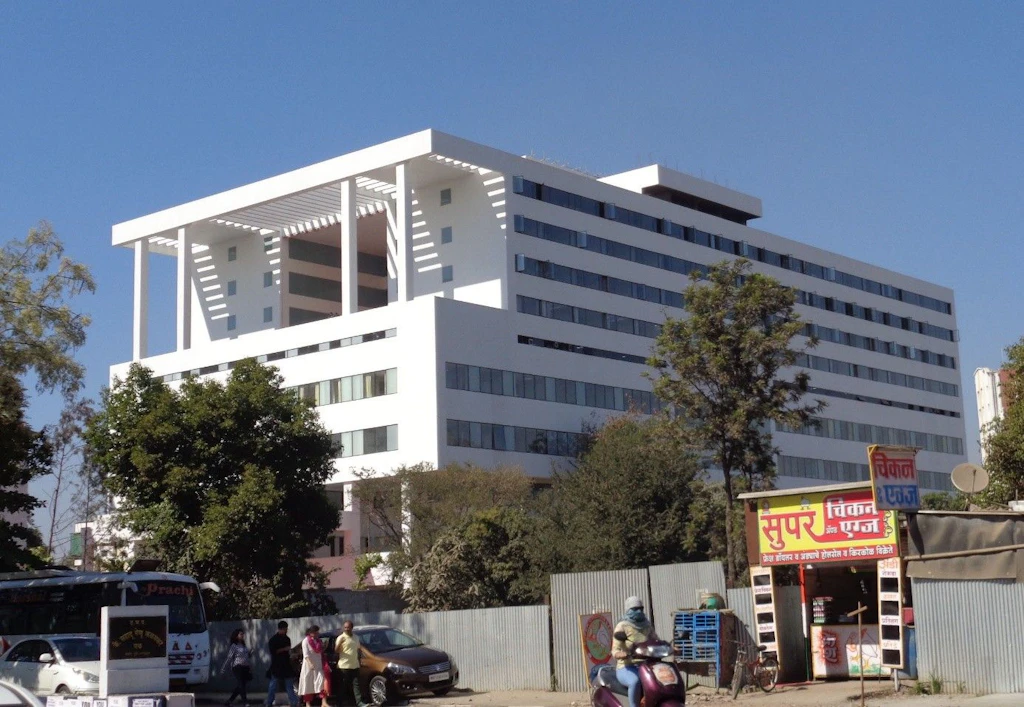
Hospital designed for energy efficiency in Pune, India
Improving energy efficiency in buildings and decarbonising energy sources are essential steps in decarbonising the building and construction sector. In many developing and emerging economies, improvements in energy efficiency can also enhance climate resilience, for instance by reducing cooling demand and easing stress on electricity grids during periods of extreme heat. At the same time, it can contribute to better health outcomes, among other effects, by lowering combustion-related air pollution.
The SDC has supported projects aimed at improving the energy efficiency of existing buildings. The following key levers are particularly important.
Energy conservation: Building users and managers with access to basic energy and temperature information can reduce unnecessary energy use through simple operational measures, such as optimising ventilation practices, adjusting heating setpoints, and reducing heating or cooling during periods of low occupancy.
Energy renovation: Reducing energy demand for heating and cooling entails improving the thermal performance of the building envelope through insulation of roofs and external walls, better windows, and reduced air leakage, and includes passive measures for cooling such as external shading, reflective roof finishes, and natural ventilation. These measures may be complemented by energy-efficient active cooling (such as air conditioning systems) and the on-site production and use of renewable energy.
Demonstration projects: The technical feasibility and real-world performance of building refurbishments help facilitate wider adoption. (Key lessons from SDC experience in influencing the built environment through practice and projects can be found here.)
Project example: PIE Mongolia
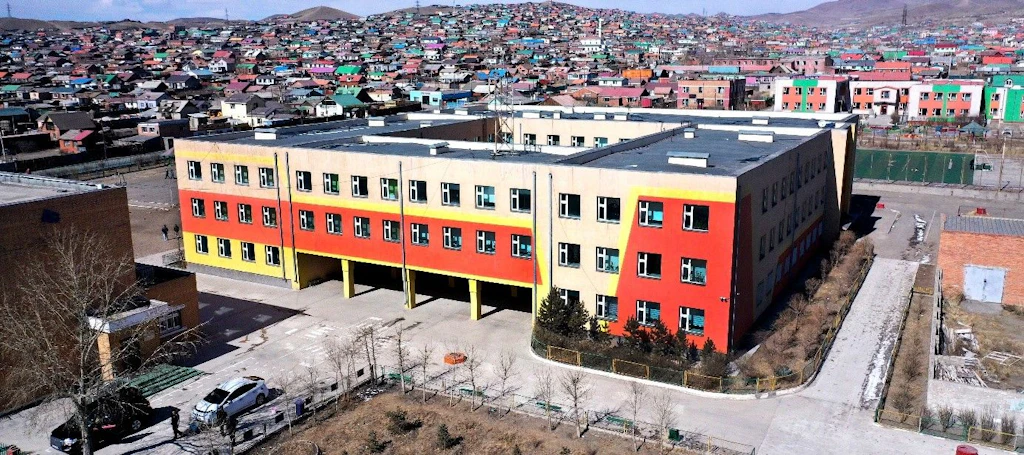
From 2014 to 2017, the SDC co-financed the Public Investment in Energy Efficiency (PIE) programme in Mongolia, in support of large-scale energy renovation of existing public buildings intended to reduce heating demand, improve comfort and cut coal-based emissions.
The programme focused on refurbishment of schools, nursery schools and other public buildings for improved thermal performance, and included insulation of building envelopes, window replacement and improvements to heating systems. These measures led to substantial reductions in heat consumption and fuel use, improved indoor comfort and health conditions, and contributed to improved energy security. A project study comparing selected kindergartens before and after refurbishment found that children’s sickness-related absence days declined by 65%.
Through technical support and the strengthening of institutions, the SDC helped embed energy efficiency and security in public investment processes and supported the scaling-up of renovation efforts across Mongolia.
Renovated school in Mongolia
Embodied emissions – those emissions that come from the production of building materials and from construction processes – account for around 11% of global energy-related CO₂ emissions.4The SDC has supported projects aimed at reducing these emissions.
The following key levers are particularly relevant when addressing building materials.
Improved design and construction quality: The more efficient use of materials and the reduction of emissions while maintaining structural safety and resilience are the fruits of proper design and construction quality. Examples include the optimised sizing of beams and columns and construction practices that use bricks, cement and other materials more efficiently.
Market enablement: Construction markets will not automatically adopt cost-competitive, low-carbon materials, but will respond to enabling regulations, robust evidence and demonstrations of performance.
Low-carbon alternatives: Embodied emissions can be reduced using low-carbon alternatives to materials such as cement, steel, and polymer-based insulation materials. Examples include clay bricks as an alternative to cement blocks, earthen construction techniques, and the use of bio-based materials. Low-carbon cement technologies (such as LC3, see below) are rapidly developing and becoming available in many markets.
Project example: LC3
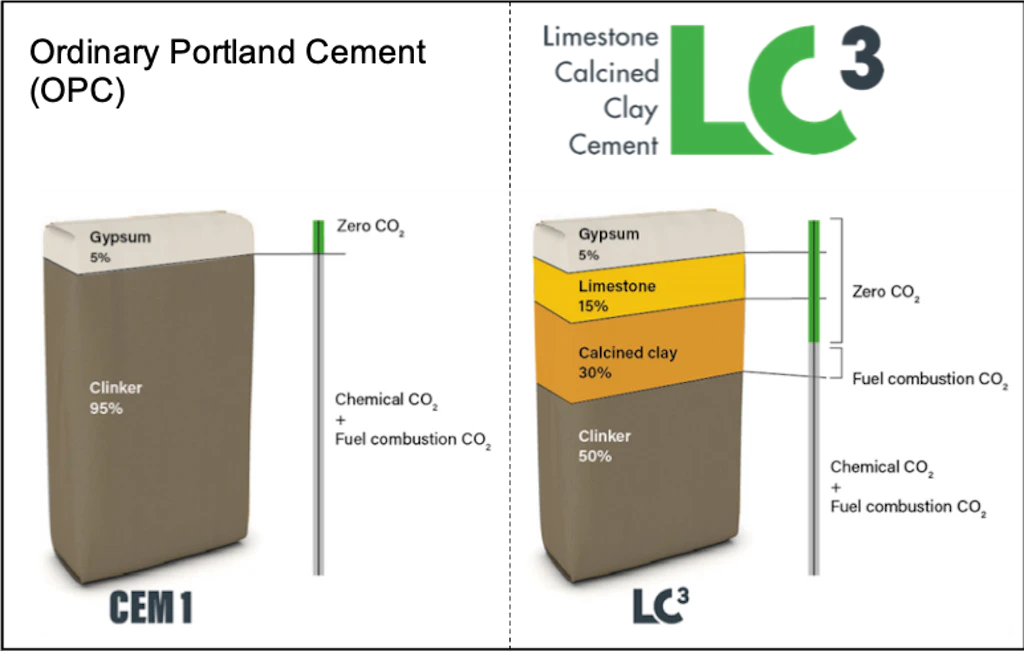
From 2013 to 2022, the SDC supported the development and global uptake of Limestone Calcined Clay Cement (LC3), a low-carbon alternative to conventional cement. With the cement industry accounting for about 7% of global energy-related CO₂ emissions6, the objective of the project was to reduce emissions from the cement and construction sector at scale.
The project supported laboratory research, pilot production and demonstration structures in India, Cuba and other countries, and provided technical assistance to cement producers through dedicated technical resource centres. (Key lessons from SDC experience with knowledge and capacity development can be found here.) The project demonstrated that LC3 contains significantly less clinker – the main source of cement-related CO₂ emissions – than conventional cement, resulting in emission reductions of around 40%, while maintaining comparable performance and relying on widely available clays and limestone. A major outcome was the integration of LC3 into cement standards, including in India, Europe and selected countries in Latin America and Africa. These milestones enabled the scaling of LC3 production and use, with multiple major cement producers and equipment manufacturers, including Holcim and Cemex, engaging in pilot and commercial projects worldwide. Estimates suggest that by the end of the project, the private sector had already investedCHF 180 million in low-carbon cement.
The SDC enabled collaboration among science, industry, and standard-setting institutions, helping to translate research results into market-ready solutions, ensure regulatory acceptance and promote market uptake.
Climate impact of LC3 compared to conventional cement
Climate change and urbanisation are intensifying heat exposure across the globe. Developing and emerging economies are particularly vulnerable to these impacts, and many of these economies are exposed to a wide range of natural hazards. The protection of people and their livelihoods in the face of these risks depends on strengthening the resilience of the built environment.
The SDC has contributed to strengthening the resilience of the built environment by applying the following key levers.
Resilient and greener reconstruction: Vernacular construction practices that rely on locally available materials such as wood or clay can be particularly effective in rebuilding after natural hazard events. Typically, these materials have zero embodied emissions and are often well adapted to local risks.
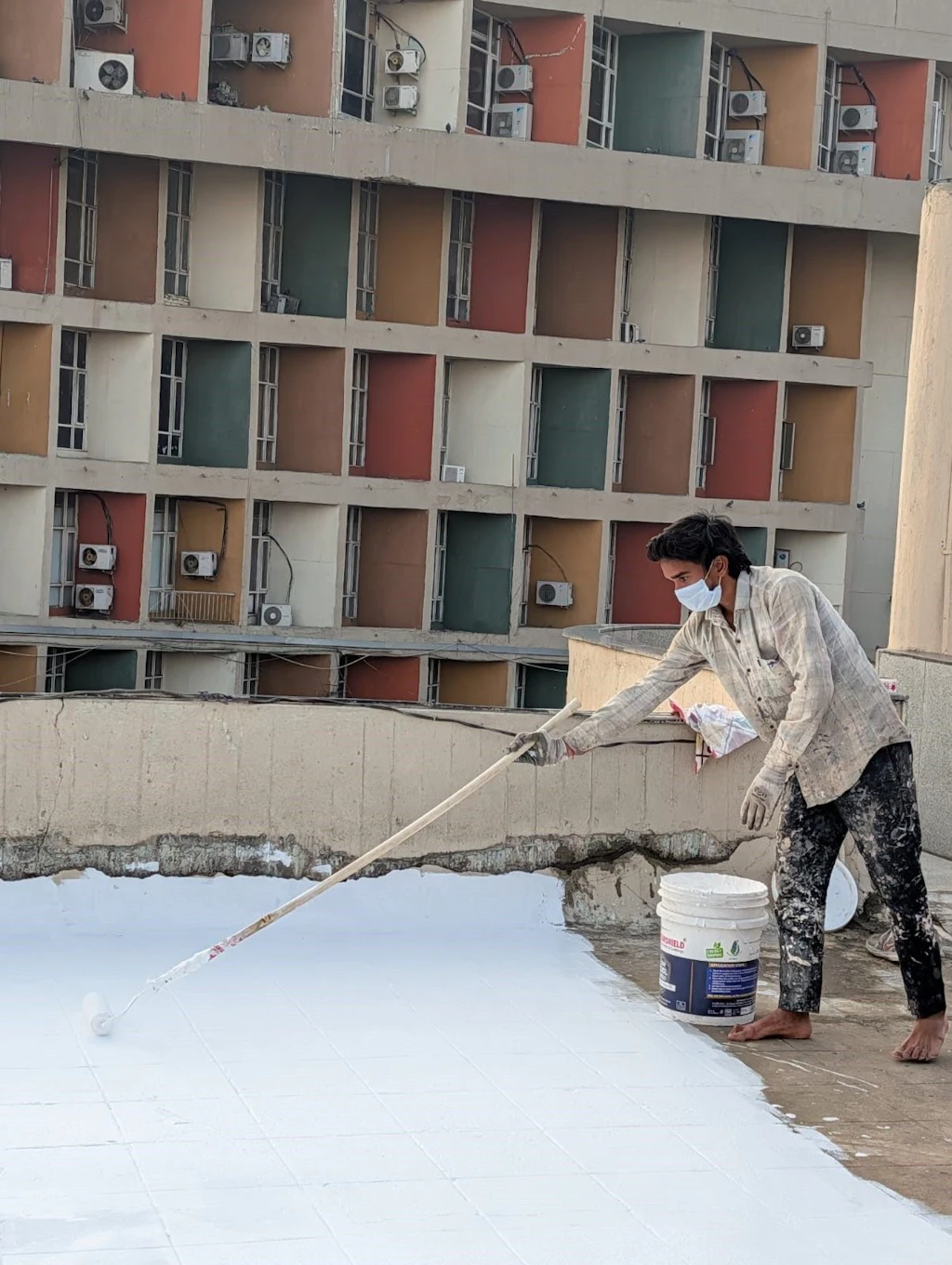
Passive design and nature-based solutions: Shading, cool roofs and urban greenery, applied at building and urban scales, mitigate urban heat island effects (see project example).
Project example: BeCool
Extreme heat is recognised as an environmental hazard and qualifies for disaster risk reduction funding under the Sendai framework. Against this backdrop, from 2023 to 2028, the SDC supports the BeCool project in India, implemented by the United Nations Environment Programme (UNEP). The project aims to improve thermal comfort and strengthen resilience to extreme heat in the built environment, while avoiding greenhouse gas emissions from cooling demand.
BeCool focuses on mainstreaming passive and nature-based cooling approaches across buildings and cities. The project supports national and sub-national governments in integrating sustainable cooling measures into policies, building codes and urban planning instruments. To help translate policy objectives into on-the-ground action, the project advances practical implementation through demonstration projects and capacity building for public authorities, the private and education sectors, and students. BeCool supports the mobilisation of investment in heat resilience and thermal comfort, particularly for affordable worker housing, including through the development of appropriate financing mechanisms.
Through BeCool, the SDC supports the scaling and replication of existing activities under UNEP’s India Cooling Programme and facilitates expansion into new thematic and geographic areas. Other countries such as Somalia have shown interest to replicate Be-Cool India in the Horn of Africa contributing to the implementation of their Nationally Determined Contributions under the Paris Agreement.
Roof painted white to increase solar reflectivity and reduce indoor heat gain in New Delhi, India
Key lessons from previous projects
Based on its portfolio of low-carbon and resilient building projects, the SDC has identified key insights, success factors and lessons learned that are relevant for future interventions. These lessons are structured along SDC lines of action – policy and governance, practice and projects, and knowledge and capacity development. In addition, overarching lessons and a checklist of practical questions for future project developers are presented below. Please note that while some insights are specific to the built environment, others are applicable more broadly.
The SDC influences the development of policies and governance structures at the global, national and sub-national levels. In the building sector, this involves contributing to the development of global frameworks, national strategies and building regulations.
Lesson 1: Mobilise political support and partners
Reforms in the building sector require sustained support at high political levels. Involving relevant ministries from the outset of an initiative increases the likelihood of influencing national strategies or building regulations. International partnerships such as the Global Alliance for Buildings and Construction (GlobalABC) or the International Energy Agency (IEA) provide important platforms for contacts and institutional support. They can strengthen the building agenda, and offer a shared orientation for reform. Diplomatic support from Swiss or other embassies can facilitate access to senior government counterparts and can positively influence political processes. Engaging with private sector actors is also essential, as their interest in new technologies, approaches and viable business models is important in promoting market uptake and in helping build momentum among policymakers for associated reforms. Highlighting social benefits, including improvements in health, comfort and improved housing quality and affordability can further support political buy-in.
Lesson 2: Know how the country-specific regulatory process works
Regulatory frameworks are among the most effective instruments for the sustainable transformation of the building sector (see also: themes --> new buildings). Embedding climate- and resource-efficient materials or technologies in technical standards and building codes facilitates wide adoption, but the process may be time-consuming. Amending building regulations usually requires long-term, multi-stakeholder engagement. New rules may affect public safety, challenge established construction practices and traditions and pose a threat to the commercial interests of engineers, architects, industry and investors. Any failure to understand how regulatory processes function in a given country or context can undermine the success of projects. In some countries, key decisions are taken at the national level; in others, at a regional or sub-national level. In large federally organised countries, reform processes tend to take more time, as divided responsibilities can slow progress. Aligning reform efforts with existing policies and making use of appropriate windows of opportunity – such as ongoing legislative revisions – can significantly increase the chances of successful regulatory change.
Lesson 3: Locally Co-create practical standards
For regulatory frameworks to have an impact and be applied effectively in practice, regulations must be clearly formulated and straightforward to implement. Engaging private sector stakeholders helps ensure that requirements are realistic, workable and cost-effective, thereby facilitating compliance. More generally, new standards should be developedjointly with local stakeholders so that ownership, responsibilities and mandates are established within partner institutions. Ultimately, the broad institutional embedding of knowledge and responsibilities helps ensure that reforms remain in place and are implemented and improved over time, even in contexts of political instability or staff turnover.
Through this action line, the SDC supports the implementation of hands-on activities. In the context of the built environment, these activities can include testing, demonstrating, scaling up, and disseminating technologies, business models, and other approaches that help reduce building emissions and/or strengthen resilience.
Lesson 1: Enable market uptake through robust business models
In the building sector, large-scale adoption of new approaches typically depends on their commercial viability. Demonstrating and communicating the cost-effectiveness of new solutions is therefore essential. However, economic viability alone is insufficient. The fragmented stakeholder landscape and differing incentives call for robust business models. Developers often bear the upfront costs of passive cooling measures, for example, while tenants benefit from lower energy costs and improved comfort. This situation highlights the need for business models that align incentives among those affected. In this context, strong collaboration with local private sector actors along with an entrepreneurial approach within project teams can support market adoption. Further, promoting individual and corporate social responsibility can play an enabling role in supporting the market uptake of sustainable solutions.
Risk aversion among public authorities, the private sector and consumers creates hurdles for new technologies, particularly when performance evidence is limited, and where impacts on building investments are significant. Demonstration projects make new solutions visible and tangible, build trust, and raise awareness (see also: themes --> existing buildings). Systematic performance monitoring and the communication of results are important, but selecting the right demonstration project is critical.
Two key factors to consider are scale and timing. While larger building projects can generate greater visibility, they are often more difficult to influence, as interventions typically represent a small proportion of overall investment volumes and large investors tend to prioritise profit maximisation. Small building projects might attract less attention and be less representative of wider building markets. Timing is equally important; intervening early in the project life cycle offers greater scope to influence building design, materials and energy systems, but also increases risks of supporting demonstration projects that are delayed or not completed. These trade-offs need to be carefully considered.
Lesson 3: Leverage vernacular building practices, particularly in reconstruction contexts.
While building regulations and popular perceptions often favour modern construction methods employing materials such as steel and concrete, experience shows that vernacular building practices can play an important role, particularly in post-disaster reconstruction (see also: themes --> resilience and reconstruction). Following earthquakes, traditional timber-stone composite systems in Pakistan, for example, have demonstrated high resilience due to their flexible structural behaviour. Vernacular practices are climate-neutral, often well adaptedto local climatic conditions and a range of natural hazards, draw on locally available materials such as wood or clay, and are embedded in local knowledge. Cash-based approaches, which provide households with financial resources rather than rebuilding houses directly, can help activate this local knowledge while strengthening local ownership and acceptance.
In the built environment, where design choices and construction practices are heavily influenced by culture, tradition and available skills, capacity building and awareness raising can make major contributions to the development of low-carbon and resilient buildings.
Lesson 1: Close gaps in critical skills and awareness
Significant development cooperation knowledge gaps relating to the building sector, particularly with regard to technical knowledge and skills required to implement new technologies and approaches, can undermine progress. Robust technical expertise in new building technologies and approaches and complementary practical know-how on implementation are the necessary antidotes. Popular perceptions of the strengths and limitations of contemporary building practices are often shaped by status-related preferences rather than technical benefits. Targeted awareness raising, supported by science-based evidence and practical demonstrations of the performance of new solutions can help address these gaps. At the same time, there is a strong interest and willingness to learn about sustainable building solutions. This interest is further fostered by Switzerland’s long-standing expertise and the engagement of strong academic partners which motivate students and young professionals to develop their skills.
The transfer of knowledge and technical expertise is not enough. For example, development cooperation cannot simply apply the voluntary Swiss MINERGIE building standard, developed for the Swiss context, directly in India. This is because there are significant differences in climatic conditions, dominant building materials, prevailing construction techniques and enforcement capacities between the two countries. The approach only becomes effective when the underlying principles of MINERGIE, such as energy efficiency (see also: themes --> existing buildings), are adapted and applied to local conditions. Academics have sometimes struggled to adapt knowledge sufficiently, but private sector partners who share a common practical language and have worked locally, can in some cases be more effective. Furthermore, given the importance of adapting solutions to the local context, the knowledge of local stakeholders is an invaluable resource. Positive results occur when international participants assume a facilitating or moderating role, and the exchange among local partners leads to jointly developed solutions.
Lesson 3: Tailor formats to different audiences
Making knowledge accessible to public authorities, building professionals, building practitioners and students across a range of backgrounds, priorities, and levels of education calls for different modes of communication. Some project implementers report positive experiences with a combination of digital formats – such as online webinars and content hubs for document sharing – and in-person activities, including practice-oriented workshops, student camps and training weeks. Overall, demand-driven and project-specific support from experts is often considered more effective than supply-driven toolkits.
The lessons that cannot be attributed to a single line of action are summarised here.
Lesson 1: Recognise that transformation in the building sector takes time
The building sector is inherently conservative in both industrialised economies and development cooperation contexts. Achieving change is challenging and requires a sustained effort – including the time and resources needed to navigate extensive building regulations, secure political support, engage complex stakeholder landscapes, address capacity and skills constraints, overcome traditions and status-related perceptions, and ensure economic viability. In practice, these challenges call for long-term engagement, and for some projects, the SDC has been involved for more than a decade.
Lesson 2: Build flexibility into projects
Clear project plans with defined milestones and linked payments are important for effective project management and for ensuring accountability to donors, but projects rarely unfold exactly as planned. Unexpected challenges may arise for example due to changing fiscal conditions, regulatory change or political transitions. Conversely, unforeseen opportunities can also emerge. While reforms to building regulations may take a long time in one country, they may progress more quickly in another. To respond effectively to such dynamics, flexibility in project implementation is crucial. Contracts must therefore allow sufficient room for adjustments, enabling the scope of work and action plans to be adapted in line with evolving trends, windows of opportunity and the interests of key partners.
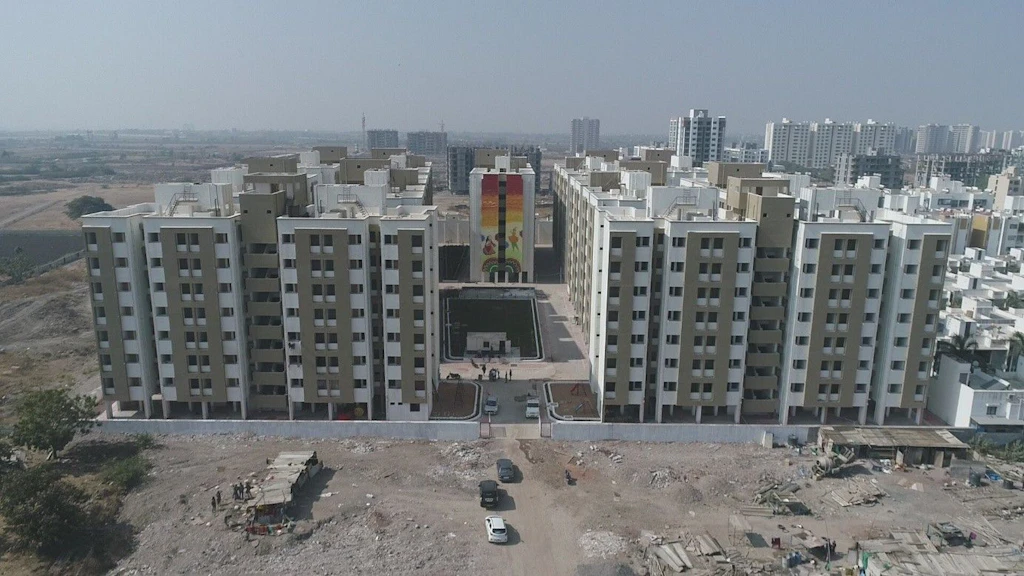
Under the BEEP project, the SDC has been involved for 15 years. View of thermally comfortable and energy-efficient affordable housing in Rajkot, India
Lesson 3: Coordinate across lines of action
Multiple lines of action are most effective when pursued in parallel. In some cases, laboratory research may lead to demonstration projects, which can in turn generate private-sector interest, build political support and eventually enable regulatory change and commercialisation. In other cases, the process may involve iterative steps and feedback loops, such as further testing before scaling up. The exact sequence and emphasis are context-specific, and coordination across lines of action is consistently important.
Lesson 4: Build the right partner mix and align incentives
Projects are most effective when they involve private sector partners who can influence market developments. Depending on the context, these partners may include an innovative individual firm, an existing building sector network, or well-connected individuals who are respected within the sector. At the same time, project staff should be aware of conflicts of interest and avoid collaborating with would-be partners whose motivation is not in line with the cooperation aim. Limiting financial contributions from development cooperation can sometimes help attract the right partners. In demonstration projects, for example, programmes have had positive experiences providing technical support while refraining from financing infrastructure investments. This requires private sector partners to invest their own resources, ensuring that those involved have a genuine strategic interest in the new approach rather than participating primarily for subsidies. The overall partner mix is equally important. A balanced combination of local and Swiss or international actors, as well as private sector and academic institutions, helps to bring together complementary strengths, including technical expertise, policy and regulatory know-how, and cultural sensitivity.
The following checklist asks practical questions to guide project developers in their application of the lessons learned. (Not every question is relevant to every project.)
Problem and context analysis
What are the main barriers to low-carbon and resilient building solutions in the local context (e.g. costs, traditions, regulatory frameworks, lack of awareness or skills)?
Have the potential overlapstointerventions of other actors such as donors and industry been assessed, and is there a strong case that the planned activity can achieve significant additional impact?
Project design
Based on the problem and context analysis, at which lines of action can the intervention achieve the greatest impact, and how should the project budget be allocated?
Does the project design provide sufficient flexibility to adjust resource allocation in response to changing conditions or opportunities?
Is there a clear understanding of how the regulatory framework and regulatory processes function in the country context, and is adequate time allocated to engage with them?
Are the proposed solutions economically viable under local market conditions? Are there viable business models that can align differing incentives among key actors (e.g. owners, developers and tenants)?
Are the trade-offs between timing and scale in the selection of demonstration projects well understood and consciously managed?
Is the intervention people-centred with technical solutions clearly linked to social benefits such as improved resilience, comfort and affordability for local communities?
Actors and partnerships
Are the necessary political contacts in place to influence regulatory change? Can international networks and diplomatic channels be leveraged where needed?
Does the project involve motivated local private sector actors with the capacity to influence market uptake? How is the local building industry and building professions organised? Are there representative industry associations and professional associations to engage as interlocutors, to develop a better understanding of the local context and to support communication and knowledge dissemination? Is the project budget designed to favour committed partners and discourage purely subsidy-driven participation?
Does the project involve reputable experts, universities or research institutions capable of strengthening credibility, generating scientific evidence on the performance of new technologies, and motivating practitioners to engage in capacity building activities? Does the project team combine technical expertise with contextual understanding to effectively adapt low-carbon and resilient building principles to local conditions?
Potential
Has the potential to build on vernacular building practices – drawing on locally available materials, skills and knowledge – been assessed?
Does the project draw on comparative advantages, such as academic expertise, experience with building standards and regulations, and diplomatic capacities?
Project examples
Building Energy Efficiency Project (BEEP) Mainstreamed and scaled-up energy-efficient and thermally comfortable building design in India for both commercial and residential buildings through strengthened competencies in building design developers, integration in architecture and engineering education, and support of regulatory frameworks for building design
Public Investment in Energy Efficiency (PIE) Improved energy efficiency and thermal comfort in Mongolia by retrofitting schools, kindergartens and other public buildings, strengthening local capacities and financing mechanisms, reducing energy consumption and emissions while improving thermal comfort and health
LC3 – A sustainable alternative for the cement industry Mainstreamed and scaled-up low-carbon cement by changing standards, improving technical capacities, demonstrating performance and enabling private sector uptake, reducing emissions from the construction sector
Passive Cooling for a Low-carbon Built Environment (BeCool) Improved access to cooling through passive measures in buildings in urban India to reduce the impact of heatwaves on human health and productivity, while decreasing energy consumption, costs and greenhouse gas emissions
Chinese Zero Emission Buildings with Swiss Know-How (ZEB China) Mainstreamed zero-emission building design in China by strengthening professional capacities, changing building codes and piloting high-performance buildings, reducing energy demand and emissions while improving indoor comfort
PROECCO Promoted climate-friendly construction in the Great Lakes region of Africa by supporting the production and market uptake of low-carbon “modern bricks”, creating jobs in the local construction sector while reducing emissions from building materials and enabling more durable, affordable and resilient housing
Capacity Building for Low-carbon and Climate Resilient City Development (CapaCITIES) Strengthened capacities for low-carbon and climate-resilient urban development in India by supporting cities and the states of Tamil Nadu and Gujarat to integrate climate action into planning, financing and infrastructure, reducing emissions while improving resilience and service delivery for urban populations
BeCool: smart buildings to fight record-breaking heat
How can growing cities stay cool without increasing emissions? Rather than relying on energy-intensive air conditioning, the BeCool initiative promotes passive cooling solutions, such as ventilation, shading, greening and reflective roofs, that keep buildings cool, protect people from extreme heat and support low-carbon, climate-resilient urban development.
5 August 2026
Build better, emit less: lessons from a long-term partnership
In this interview, Christian Frutiger, Assistant Director General of the Swiss Agency for Development and Cooperation and head of the Thematic Cooperation division, shares lessons from long-term partnerships that are helping promote buildings that are both more energy-efficient and more resilient to the effects of the climate crisis, while strengthening local capacities for sustainable urban development.