The SDC has established a system of indicators to monitor the implementation of Switzerland’s International Cooperation Strategy 2025-2028 (IC Strategy). This system includes key performance indicators as well as policy markers for the monitoring of financial targets. The indicators used to monitor and report on C/D/E activities are presented in this section.
The SDC’s key performance indicators follow the four objectives of the IC strategy and include the Aggregated Reference Indicators ARI as well as the Thematic Reference Indicators TRI.
Whereas the ARIs focus on the output level and allow the communication on selected achievements across a wide range of thematic areas and geographical contexts, the TRIs allow the measuring of progress towards outcomes to which the SDC contributes and can thus be used for steering.
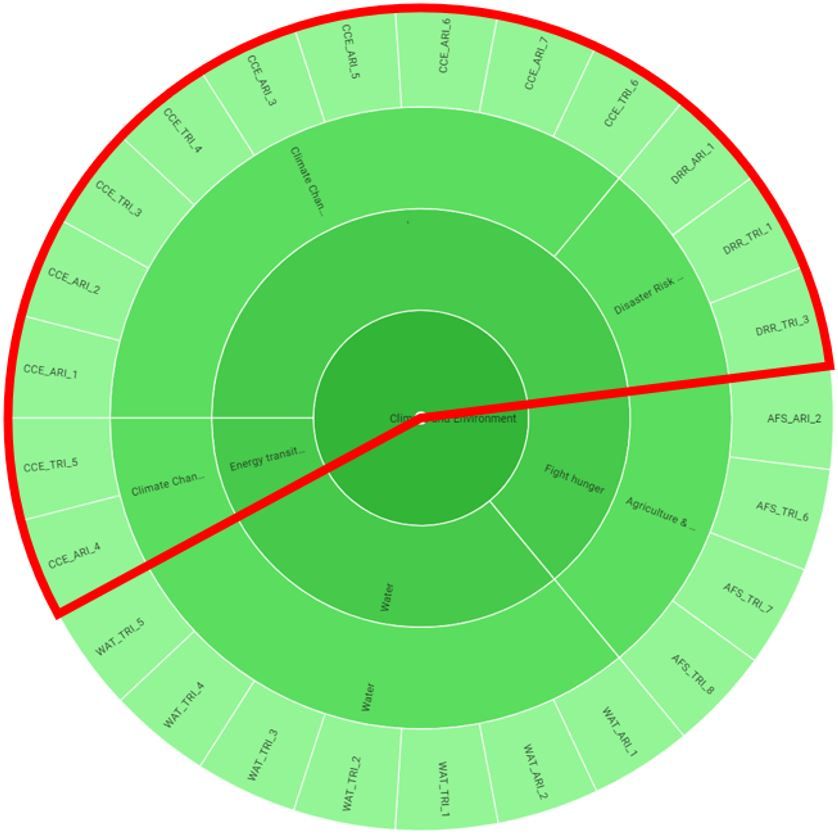
Accordingly, C/D/E activities of SDC which contribute to the overarching goal on climate and environment of the IC Strategy are monitored through a set of C/D/E specific ARIs and TRIs. These performance indicators are reported to and monitored through the SDC’s Results Data Management RDM system (internal access only). Together with the indicators for water and food security, the C/D/E indicators cover the ICS’ goal on climate and environment (CCE_ and DRR_ ARIs and TRIs as outlined in red in the chart).
As ARI and TRIs are essential for thematic monitoring at the level of the institution, the use of these indicators is strongly recommended. Thus, before creating a new context specific indicator for operational projects/programmes and cooperation/programmes, a critical assessment has to be made to determine whether an existing ARI/TRI already meets the requirements.
The current indicators for C/D/E are presented in the following. A complete list for all SDC themes in the RDM Indicator browser is available for internal access only.
Link to overarching frameworks These goals and specific objectives under Climate, DRR and Environment contribute to the Sustainable Development Goals (SDGs), mainly SDG 13 (Climate action), but also SDGs 1 (No Poverty), 3 (Good health and wellbeing), 6 (Clean water and sanitation), 7 (Affordable and clean energy), 11 (Sustainable cities and communities) and 15 (Life on land).
Policy Markers
What are Policy Markers and which kind of Policy Markers do we use in C/D/E
Policy Markers are a tool used in international cooperation to track and report on the thematic focus of development activities. They allow for a standardized assessment of whether and to what extent a project contributes to specific policy objectives, such as gender equality, climate change, or biodiversity. Each project is assessed and marked according to whether the policy objective is its principal, significant, or not targeted aim. They form the basis for Switzerland’s international reporting on e.g. climate finance.
The C/D/E area is covered by four different Rio PMs (biodiversity, desertification, climate change mitigation, climate change adaptation) and one Policy Marker for DRR. The Rio PM get their name from the Rio Conventions that cover the respective topic:
Climate change mitigation includes the reduction of greenhouse gas emissions, protection or enhancement of greenhouse gas sinks and reservoirs; support for institution building and capacity development, environmental planning; and support in reaching the obligations of the partner country under the Paris Agreement. Important: The purchase of certificates to offset CO2 emissions for air travel is not sufficient for marking a project as significant or principal.
Climate change mitigation can be done through direct measures (direct reduction of greenhouse gas emissions or increase of greenhouse gas sinks such as forests and carbon-rich ecosystems) or indirect measures (improving the policy framework of the target countries, improving financial mechanisms for climate change mitigation, generic support to countries to achieve their climate change mitigation targets).
Examples:
Outcome X has a clear link to CCM and therefore the selection SIGNI is justified.
The intervention strategy highlights the use of renewable energy as a main energy supply for the school district and therefore the project is marked as SIGNI.
Project component X builds capacity for sustainable forest management. It is estimated that about 10,000 hectares will not be deforested and will therefore be available as an important greenhouse gases reservoir and thus is marked as SIGNI.
The project focuses on mainstreaming and scaling up energy efficient and thermally comfortable building design and on promoting the on-site use of renewable energy sources (PRINC).
Climate change adaptation includes reducing the vulnerability of humans or natural systems to current and expected impacts of climate change and climate-related risks by maintaining or increasing adaptive capacity and resilience. This encompasses a range of activities from information and knowledge generation to capacity development, planning and the implementation of climate change adaptation actions. Important: More income in itself is not an adaptation or resilience measure. Measures within activities with a focus on better livelihood need to show a clear link to climate change adaptation.
Climate change adaptation can be done through direct measures (planning and implementation of concrete adaptation measures) or indirect measures (improving the policy frame of the target countries, improving financial mechanisms for climate change adaptation, generic support to countries to achieve their climate change adaptation targets including measures to increase the information base and adaptation capacity). An activity carried out in the context of climate change can only be marked for climate change adaptation if it directly addresses specific adaptation measures.
Examples:
Outcome X significantly contributes to CCA by supporting climate-proof irrigation and therefore the selection SIGNI is justified.
The intervention strategy highlights the focus on sustainable agriculture for adaptation to climate change in rural drought areas and therefore justifies a SIGNI marking.
The marker is on SIGNI as the measures outlined in the credit proposal are designed to provide water infrastructure and wastewater services that reduce the vulnerability of the affected water and wastewater infrastructure to flooding.
The main goal of the project is linking initiatives, stakeholders and knowledge for climate resilient livelihood security including vulnerability to climate change (PRINC).
Biodiversity in this context includes activities for the conservation of biological diversity; for the sustainable use of ecosystems, species, and genetic resources; and for the sharing of the benefits arising out of the utilisation of genetic resources. Important: Also included under biodiversity are projects that focus on the protection and sustainable use of ecosystem services – sustainable use and management of natural resources (land, forest and water).
Such projects can entail direct measures (ecosystem conservation, establishment or management of protected areas, restoration of environmental damage and of ecosystems, support for biological diversification such as through agroforestry) or indirect measures (integrating biodiversity concerns in legal policy, financing and budgeting frameworks; research; and support for target countries’ efforts to fulfil the obligations under the Convention on Biological Diversity or other National Biodiversity Strategies and Action Plans NBSAPs).
Examples:
The overall strategy aims for ecological restoration or ecosystem protection such as wetlands or forests (PRINC).
Sanitation and waste management activities contribute to protecting biodiversity by avoiding pollution (SIGNI).
Increased access to efficient stoves among rural households and enhanced local reforestation with native tree species work to ensure the sustainability of trees as an energy source (SIGNI).
Support for microfinance institutions offers a new agricultural product that has been developed to support sustainable and environmentally friendly rural enterprises (SIGNI).
Sustainable trade initiatives have the overall purpose of assuring the environmental sustainability of traded goods (SIGNI).
Capacity building for local municipalities to implement urban planning activities include an ecological, sustainable, socially balanced and efficient steering of use of land (SIGNI).
Adapting climate-smart agricultural technologies and strengthening the implementation of relevant national policies and programmes increase and improve food security and poverty reduction (SIGNI).
Combatting desertification in this context includes mitigating the effects of drought in arid, semi-arid and dry sub-humid areas through prevention and/or mitigation of land degradation, rehabilitation of partially degraded land or reclamation of desert land.
Direct measures include protection of arid and semi-arid ecosystems, the repair of environmental damage, and sustainable management of land and water resources. Indirect measures include integrating desertification concerns into legal policy frameworks, research, capacity building, and supporting the target countries efforts to fulfil their obligations under the United Nations Convention to Combat Desertification, for example their voluntary Land Degradation Neutral targets.
Examples:
Preparation of strategies and action programmes to combat desertification and mitigate the effects of drought; establishment of drought early warning systems; strengthening of drought preparedness and management (PRINC)
Rehabilitation of land, vegetation cover, forests and water resources (PRINC)
Conservation and sustainable management of land and water resources (SIGNI)
Sustainable irrigation for both crops and livestock to reduce pressure on threatened land; alternative livelihood projects (SIGNI)
Measures to promote the participation of affected populations in planning and implementing sustainable resource management or improving security of land tenure in arid areas (SIGNI)
DRR aims at preventing and reducing hazard exposure and vulnerability to current or future disaster risk, increasing preparedness for response and recovery, and strengthening climate and disaster resilience. Not all types of hazards (societal, biological) are considered in DRR at SDC (see detailed table🔗).
Important: Emergency response activities should not be marked with the policy marker DRR. The Sector Disaster Risk Reduction scores, by definition, PRINC objective.
This can be done through implementing integrated and inclusive economic, structural, legal, social, health, cultural, educational, environmental, technological, political and institutional measures that prevent and reduce exposure to hazards and vulnerability to disasters; increase disaster preparedness for relief and recovery; and in this way strengthen resilience.
Examples:
The main objectives of the project are to restore infrastructure with disaster-resilient features and to provide associated social services (“build back better”) and therefore the selection PRINC seems justified.
Outcome X has a clear link to DRR, it includes DRR relevant elements (hazard maps, etc.) in land use planning and therefore the selection SIGNI is justified.
The intervention strategy highlights the focus on sustainable agriculture for adaptation to climate change in rural drought areas, and therefore strengthens the resilience to future drought events (SIGNI).
The measures mentioned in the credit proposal include strengthening crisis management structures for natural hazards such as an urban search and rescue team as well as organisational matters, or training of health care providers in disaster preparedness and response (PRINC).
The output of the project is an early warning, alerting and emergency information system, and contingency planning for floods (PRINC).
One of the outcomes tackles the drafting and implementation of national or local disaster risk management strategies and/or finance and/or risk transfer mechanisms (SIGNI).
The measures mentioned in the credit proposal outline that disaster-resilient elements in the existing
Application of Policy Markers
The Policy Markers are applied in a consistent and transparent manner to all activities of Switzerland’s development cooperation and humanitarian aid. As mentioned above, the PMs can take 3 values, namely Principal, Significant or Not Targeted:
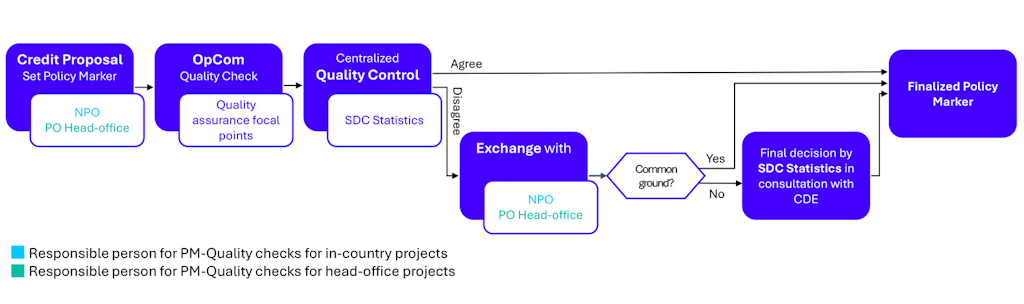
Effective reporting and steering purposes depend on the accurate and consistent assignment of Policy Markers by the respective programme manager. The correct assignment will need to be verified during the approval process of an intervention, in close coordination with the quality assurance focal points in the applying unit and the SDC statistics team (see figure below).
The following section focuses on the content-related criteria for assigning a policy marker correctly—that is, how to assess whether a marker applies as principal, significant, or not targeted, based on the project’s objectives, activities, and indicators.
Key Considerations for Marker Assignment
Visibility in the Entry/Credit Proposal: The justification for marking a project as principal or significant must be clearly reflected in the credit proposal. The policy marker’s relevance should be evident in the project’s description, objectives, outcomes, or activities.
Result Indicators: In cases where the credit proposal does not provide sufficient clarity, project indicators in the SDC logframe can be used to assess the relevance of the policy marker. For example, a project can be considered significant if more than 50% of shocks considered in a shock-responsive social protection project are climate-related shocks. The focus should be clearly on the outcome and impact level for SIGNI/PRINC rating. However, an indicator alone is not sufficient without being clearly reflected in the project narrative.
·Additionality: Ensure that actions contributing to the policy marker are additional and ambitious.
Guiding Questions for Policy Marker Justification
Before assigning a policy marker as significant or principal, the following questions should be considered:
Objective: Is the marker-relevant topic explicitly mentioned as an objective of the project?
Activities: Are there dedicated activities that clearly contribute to this objective?
Indicators: Are there specific indicators tracking results related to the marker?
Resources: Is a notable share of the budget allocated to related activities?
Ambition: Does the project go beyond business-as-usual or standard good practice?
Justification: Can you provide a 1–2 sentence justification of why the marker is assigned?
Support for Policy Marker Assigment through CEDRIG
The Climate, Environment and Disaster Risk Reduction Integration Guidance (CEDRIG) is the SDC’s mainstreaming tool for integrating climate, environmental, and disaster risk considerations into strategies and projects. It supports users in identifying risks to, and impacts of an intervention, and in defining appropriate optimisation measures.
If a CEDRIG assessment has been conducted and has identified climate or environment related risks or impacts that need to be addressed through specific measures in the project design, and if these measures are explicitly reflected in the credit proposal, this may justify assigning the corresponding Rio marker and/or policy marker for DRR. However, it remains essential to assess whether it is truly a relevant objective of the project, and whether the measures taken are of sufficient scope and significance to warrant the marking. The use of CEDRIG does not substitute for a qualitative assessment of the project’s overall orientation and budget relevance in relation to Rio and DRR objectives.
Data Entry in SAP
Marker decisions must be reflected in SAP and are subject to quality control. When in doubt, consult your C/D/E thematic advisor or contact the SDC statistics team. After the final OpCom, Policy Markers may no longer be modified.
Further reading
Overall information on all PMs used within SDC can be found in the SAP Manual. In the following, some additional resources are highlighted, including official OECD guidance documents and SDC guidelines:
Rio Marker Handbook (Offers detailed definitions and examples for applying climate-related markers)
OECD Indicative Sector Tables (These tables list examples of typical activities by sector and how they are usually marked. They help assess what is likely to qualify as Principal, Significant, or Not Targeted. Note: These are not binding but provide useful orientation—especially when projects don’t fit obvious categories)