
Moving chalcogenide materials closer to application Bright crystals
Dübendorf, 13.10.2026 — Chalcogenides are versatile materials that are the subject of active research for solar cells, photodetectors and other light and energy conversion applications. Researchers at Empa’s Transport at Nanoscale Interfaces laboratory have for the first time successfully measured chalcogenide perovskites' light-emission efficiency, showing that they are much more efficient at emitting light than expected. The researchers are also exploring promising superconducting and quantum properties in a needle-like form of the material that was previously considered an undesirable byproduct.

A typical solar cell is made of crystalline silicon and converts about 20 percent of the incoming sunlight into energy. This is the most common way to manufacture a solar cell – but not the only one. Other materials can, for example, enable lightweight and flexible cells, require less energy during manufacturing, or increase their efficiency.
Perovskite solar cells are a promising alternative. In materials science, the term “perovskite” does not refer to a specific chemical compound, but rather to a type of material structure. The best-known representatives are halide perovskites, which are the subject of active research at Empa and elsewhere and are being commercialized by the Empa spin-off Perovskia Solar. However, other materials can also adopt this crystalline perovskite structure.
A rising star in the world of perovskites are the so-called chalcogenide perovskites. Chalcogenides are stable, consist of non-toxic elements that are abundant in the Earth’s crust, and have the necessary optical and electronic properties for solar cells and similar applications – at least in theory. This is because, until now, one of the most important properties – the efficiency of light emission – had not been experimentally demonstrated in these materials.
A team of Empa researchers led by Mirjana Dimitrievska, in collaboration with Susan Schorr from the Helmholtz-Zentrum for Materials and Energy in Berlin and other partners, has now shown light emission efficiency in chalcogenide perovskites for the first time. The researchers have published the results of their study in the journal Advanced Optical Materials.
“Seeing” the material
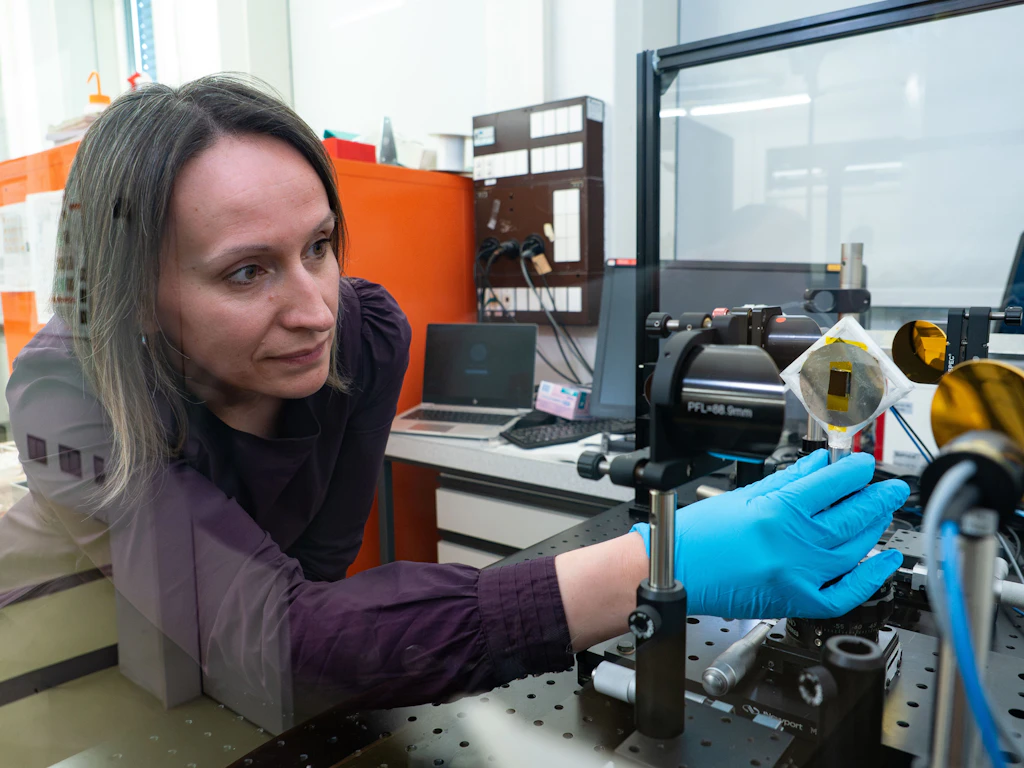
To tease photoluminescence – the ability to “light up”, so to speak – from the material, Empa researchers investigated a crystal of barium zirconium sulfide, a chalcogenide perovskite, which was produced at the Helmholtz Center. To do so, they employed advanced spectroscopic methods, a specialty of Mirjana Dimitrievska’s research group. “We have demonstrated that the material exhibits relatively strong photoluminescence. However, when it is produced as a thin film, this photoluminescence is strongly quenched by defects introduced during synthesis and processing,” explains the researcher. “Our results on single crystals though match the theory very well.”
The discrepancy between theory and practice is a fundamental aspect of materials science. “Material development usually begins with theory,” says Dimitrievska. “Computational materials scientists use theoretical models and calculations to identify which materials might be suitable for a specific application. These materials are then synthesized and processed into initial prototype components, as parts of devices such as solar cells or photodetectors, to see how they perform and if they meet expectations.”
When practice deviates from theory, it is up to spectroscopy experts like Dimitrievska to determine the why. “We can establish, for example, whether the synthesis process was suboptimal and the material has too many defects, or whether the electrical connections in the prototype device are the issue,” she explains. Based on these findings, both the synthesis and the processing of the material are further refined – until it is ready for application. There is still a great deal of development work to be done before chalcogenide perovskites can be used in practice. However: “Our study has shown that these materials have great potential and that further research into them is worthwhile,” Dimitrievska concludes.
A byproduct makes a name for itself
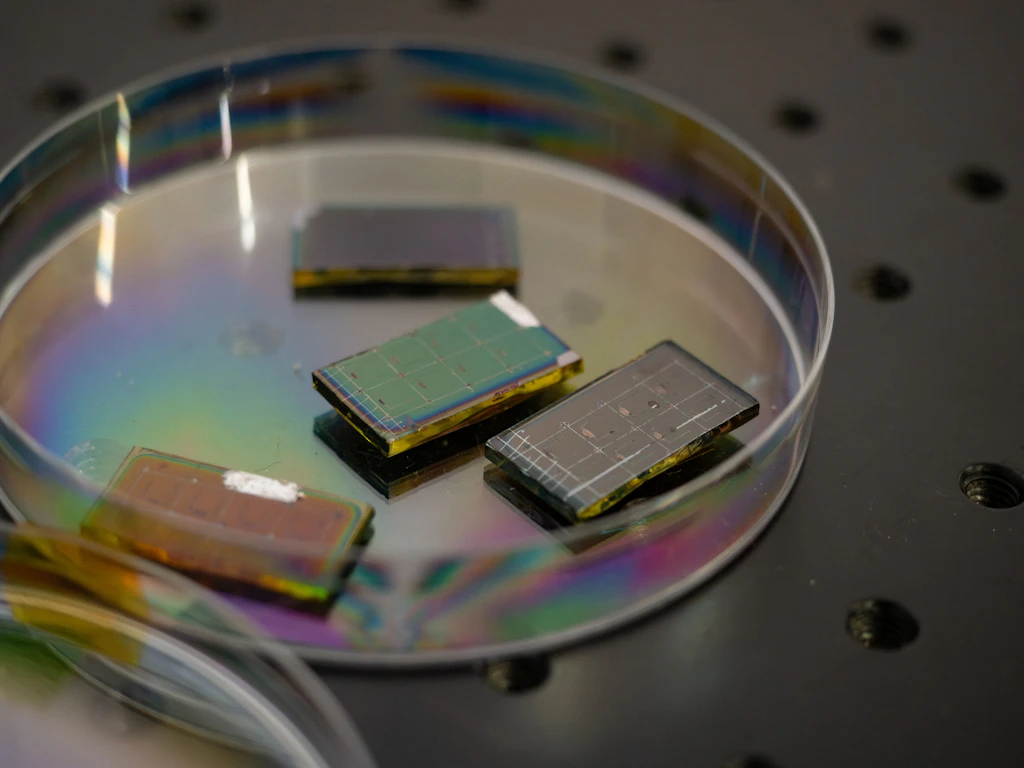
Potential applications may change as the material is developed. Materials for solar cells are also of interest for other optoelectronic applications, such as photodetectors. And sometimes, entirely unexpected applications emerge. During the synthesis of chalcogenide perovskites from their constituent elements, a byproduct is formed. Instead of the crystalline perovskite lattice, tiny needle-like structures with a hexagonal cross-section are formed. This previously undesirable phase has astonishing properties. The chalcogenide needles polarize, refract and conduct light in unique ways, as well as showing potential as superconductors as well as quantum materials.
In a project supported by the Swiss National Science Foundation (SNSF) as part of its international Weave program, Dimitrievska and her team, in collaboration with Friedrich-Alexander University Erlangen-Nürnberg in Germany, now aim to investigate these “quantum needles,” further develop their synthesis, better understand their unique properties, and integrate them into the first photonic and electronic components.
Further Information
Dr Mirjana Dimitrievska
Empa, Transport at Nanoscale Interfaces
Phone +41 58 765 45 32
mirjana.dimitrievska@empa.ch
Literature
RS Nielsen, ÁL Álvarez, Y Tomm, G Gurieva, A Ortega-Guerrero, J Breternitz, L Bastonero, N Marzari, CA Pignedoli, S Schorr, M Dimitrievska: BaZrS3 Lights Up: The Interplay of Electrons, Photons, and Phonons in Strongly Luminescent Single Crystals; Advanced Optical Materials (2025); doi: 10.1002/adom.202500915