
First positrons for the Future Circular Collider
Villigen, 24.08.2026 — At Paul Scherrer Institute PSI, first positrons have been successfully produced at a test source for CERN’s proposed next-generation particle collider, which could succeed the Large Hadron Collider. The source, installed at the X-ray free electron laser SwissFEL, uses new technologies including high-temperature superconducting magnets to achieve a high yield of positrons. The achievement shows the feasibility of the positron-source concept and marks an important milestone in developing the technologies needed for electron-positron colliders.
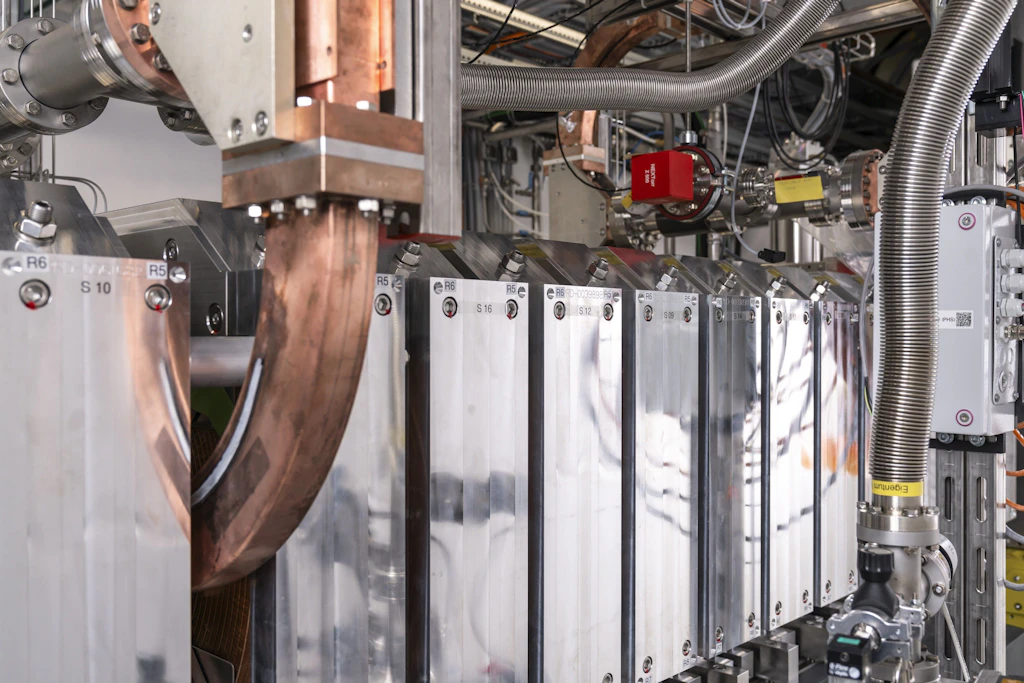
In a bunker underground at the Paul Scherrer Institute PSI in Aargau, Switzerland, positrons have now been generated at the proof-of-principle test source. “These are the first positrons for the Future Circular Collider project, so it’s an important milestone,” says Paolo Craievich. The physicist from the PSI Center for Accelerator Science and Engineering co-leads the PSI Positron Production project, known as P³, together with Riccardo Zennaro.
The Future Circular Collider (FCC) is a proposed 91-km particle accelerator, currently under study as a possible successor to the Large Hadron Collider in the 2040s. Housed in a tunnel beneath the French-Swiss border region near CERN at an average depth of 200 metres, the collider will smash electrons into positrons – their antiparticles. This will open new paths for exploring fundamental questions about the nature of the universe that lie beyond the reach of current colliders.
One of the collider’s major technical challenges is producing enough positrons and efficiently collecting them into a beam – something existing technologies cannot yet do on the scale required. Researchers at PSI have therefore spent the past five years developing a more powerful positron source, now installed at SwissFEL.
Increasing the positron yield
The prototype positron source is tested using accelerated electrons from SwissFEL. These electrons strike a tungsten target and generate a shower of positrons. The job of the positron source is to capture the positrons and create a tight beam using strong magnetic fields.
“When the electrons hit the target, the positrons are produced travelling in many different directions,” explains Riccardo Zennaro from the PSI Center for Accelerator Science and Engineering. “The challenge is to collect as many of them as possible and focus them into a beam. Normally, a large proportion is lost at this stage. Our initial results suggest that the new system could capture enough positrons to meet the FCC specifications.”
Technology beyond conventional limits
At the heart of the positron source is the capture solenoid: a high-temperature superconducting magnet, which surrounds the target. An extremely high magnetic field is necessary to capture as manypositrons as possible.
The demands surpassed the limits of conventional superconducting magnet technology, and so magnet experts at PSI developed a compact magnet capable of maintaining exceptionally strong fields while remaining stable during operation. This magnet is designed to reach a field of around 15 tesla. For comparison, the capture magnet used at the SuperKEKB positron source in Japan – one of the highest-performing positron sources currently in operation – reaches 3.5 tesla.
Beyond the capture solenoid, further novel components guide, separate and measure the particles produced at the target. Radiofrequency devices accelerate and bunch the positrons, so that they can be efficiently transported and – eventually – injected into a collider. Newly developed diagnostics measure the number of positrons generated, together with their timing and energy, allowing the researchers to assess how well the new source works.
The generation of first positrons shows that these different components work together. Michael Benedikt, FCC Project Leader at CERN comments on the milestone: “These results mark an important step for the FCC, validating the proposed approach for the positron source and demonstrating its potential to meet the collider’s demanding requirements.”
He adds: “My congratulations go to the P³ team and the many colleagues across PSI who made this achievement possible, together with their collaborators from CERN, IJCLab–Université Paris-Saclay and KEK. This work also reflects the vital support through the Swiss CHART programme, helping to build the expertise and advanced technologies needed to turn the FCC vision into a technically credible project.”
Scaling up for the FCC
Now that first positrons have successfully been produced, researchers will increase the beam intensity and optimise the system. “Our goal is to scale up positron production to meet the specifications of the FCC, and to build experience with this type of positron source,” says Zennaro.
The positron source forms part of a wider collaboration between PSI and CERN on the design of the FCC injector – the system that would produce, accelerate and prepare the electron and positron beams before they enter the collider. As part of Switzerland’s contribution through the Swiss Accelerator Research and Technology (CHART) collaboration, the work draws on PSI’s experience in designing, building and operating accelerator-based facilities.
“With the experience and know-how gained from SwissFEL, we can contribute to innovations needed for future electron–positron colliders,” comments Craievich. “The scale would be much greater. For SwissFEL, we built 120 radiofrequency structures. For the FCC injector, 440 would be needed.”
Technology for the future
Beyond electron-positron colliders such as the FCC, the individual technologies have wider applications. For example, the high-temperature superconducting magnets can reliably maintain high fields at warmer temperatures, allowing for savings on energy consumption for cryogenic cooling compared to low-temperature superconducting magnets: “This is the first time in the world that high-temperature superconducting magnets have been used in a real accelerator,” says Craievich. “In the future, the technology is likely to be used in accelerators in functions such as bending magnets.”
The magnet technology developed at PSI is also being investigated for applications in medical technology, including as proton therapy gantry magnets, and in fusion research.
Text: Paul Scherrer Institute PSI/Miriam Arrell
About PSI
The Paul Scherrer Institute PSI develops, builds and operates large, complex research facilities and makes them available to the national and international research community. The institute's own key research priorities are in the fields of future technologies, energy and climate, health innovation and fundamentals of nature. PSI is committed to the training of future generations. Therefore about one quarter of our staff are post-docs, post-graduates or apprentices. Altogether PSI employs 2300 people, thus being the largest research institute in Switzerland. The annual budget amounts to approximately CHF 450 million. PSI is part of the ETH Domain, with the other members being the two Swiss Federal Institutes of Technology, ETH Zurich and EPFL Lausanne, as well as Eawag (Swiss Federal Institute of Aquatic Science and Technology), Empa (Swiss Federal Laboratories for Materials Science and Technology) and WSL (Swiss Federal Institute for Forest, Snow and Landscape Research).
Contact
Dr. Paolo Craievich
PSI Center for Accelerator Science and Engineering
Paul Scherrer Institute PSI
+41 56 310 24 90
paolo.craievich@psi.ch
[English, German, Italian]