
What a dry meteorite tells us about water on Mars
Villigen, 13.08.2026 — Detecting water where none remains today: neutron and X-ray tomography make it possible. In an international study conducted with the participation of the Paul Scherrer Institute PSI, researchers have brought to light macroscopic hydrogen-rich regions inside a Martian meteorite. The findings provide evidence for early water–rock interactions on Mars.
The Red Planet was not always the dusty desert we see today. Mars once held water: data from orbiters and rover measurements suggest that liquid water even flowed on its surface – and that today it persists mainly as chemically bound hydrogen locked into minerals in the rock.
However, our understanding of how old these hydrogen-bearing minerals are, where they occur and in what concentrations is still incomplete. Yet such details are crucial to better understanding the early environment of Mars – and the extent to which it may have been habitable at that time.
In an interdisciplinary collaboration, a research team from Denmark, Sweden and Switzerland have been investigating water on Mars – not on Mars itself, but in a piece of Martian rock that was flung to Earth many millions of years ago: NWA 7034 – better known as “Black Beauty.” Although this Martian meteorite does not contain liquid water, when water reacts with rock, it leaves behind chemical traces – such as altered iron compounds or hydrated minerals. It was precisely these traces that the researchers wanted to reveal inside the sample.
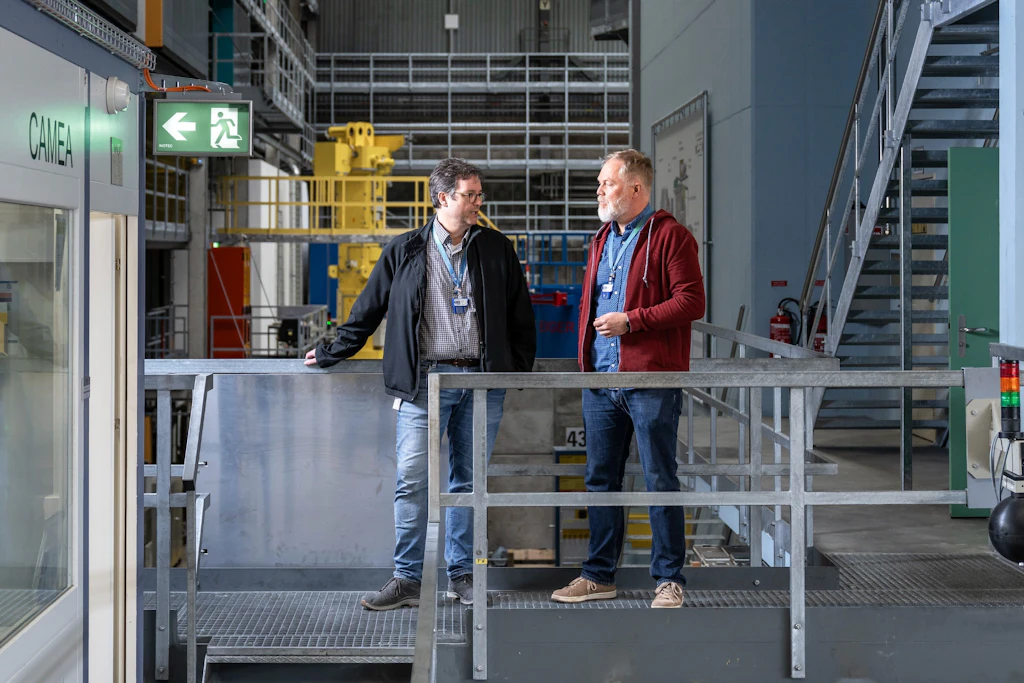
To achieve this, the team combined two complementary imaging techniques: neutron and X-ray tomography. The neutron measurements were carried out at the Swiss Spallation Neutron Source SINQ at PSI. “Neutrons are particularly sensitive to hydrogen,” explains PSI scientist David Mannes, who performed the neutron tomography at PSI together with Anders Kaestner. “In combination with X-ray tomography, we were not only able to detect tiny hydrated minerals, but also, for the first time, visualise larger, macroscopic hydrogen deposits.”
The hydrogen-rich signatures are found in very old Martian rock and occur in clearly definable, macroscopic areas. This suggests that water reacted with the still-young Martian crust at an early stage. The researchers have reported their findings in the journal Geophysical Research Letters.
Looking inside “Black Beauty” – with neutrons
“Black Beauty” – a piece of the Red Planet – was once hurled into space by a meteorite impact on Mars and, after a long journey, finally landed in the Moroccan Sahara. The rock fragment, weighing around 320 grams, contains material that is up to 4.48 billion years old, making it one of the oldest known fragments of the Martian crust.
This coveted piece of rock has already been extensively examined in previous studies. An initial estimate of its water content was obtained by heating the meteorite under controlled conditions and analysing the water released. In later work, researchers examined micrometre-thin sections under the microscope to investigate the mineralogy of “Black Beauty” in detail. All of these studies reached a similar conclusion: “Black Beauty” is full of water – or at least full of traces of it.
However, one of the limitations of such studies is that they either provide only quantitative information about the bulk water content or are confined to small, local sections of the rock. They do not reveal how hydrated minerals are distributed throughout the meteorite as a whole.
This was the starting point for the new study: for the first time, the international team combined neutron and X-ray tomography to examine a contiguous section of the meteorite in three dimensions and non-destructively. “A section of Black Beauty measuring 12 x 8 x 2 millimetres was sent to Switzerland from Copenhagen by parcel service,” Anders Kaestner recalls with a smile. “When it arrived here, we placed the sample in our beamline and reconstructed its internal structure using neutrons.”
Two methods – one complete picture
Most of us are familiar with the X-rays taken in hospitals: they essentially work like a shadow being cast. Radiation passes through an object, is attenuated or scattered depending on the material, emerges on the other side and is detected – producing a two-dimensional image of the internal structure. Tomography takes this a step further: by rotating the object through 360 degrees in the beam, its internal structure can be reconstructed fully in three dimensions, without destroying the sample.
X-rays are particularly well suited for revealing the distribution of heavier elements such as silicon or iron. Light elements such as hydrogen, on the other hand, provide little contrast in dense rock. “When we looked at the X-ray tomogram of the meteorite, we could already see many larger ‘holes’ in the otherwise dense rock,” says Anders Kaestner. “It was only by using neutron tomography that we were finally able to show that these holes are not empty, but that they contain hydrogen-bearing material.”
The time capsule from the Martian crust
To understand these hydrogen signatures, they must first be placed in a geological context: Black Beauty is not a simple, homogeneous piece of rock, but a colourful patchwork of very old crust fragments. “In geology, we refer to this as breccia,” explains Mars geologist Katrine Wulff Nikolajsen from the University of Copenhagen, who participated in the study as a co-author and Mars expert. “This is a structure consisting of debris from different geological periods that has been baked together like rock concrete.”
Black Beauty’s complex composition is the result of multiple powerful impact events on the Red Planet. “Events like this inject enormous amounts of energy into the system,” says Wulff. “Rock from different layers is churned up, broken apart, partially melted and remixed.” A later impact ultimately imparted enough energy to the breccia to overcome Mars’s gravitational field and set it on its journey to Earth.
What fell in the Moroccan Sahara as Black Beauty is therefore a kind of geological time capsule containing material from different eras of the Martian crust – including the oldest rock samples from the Red Planet known to us. “Using our two analysis methods, we found that the hydrated traces are not distributed homogeneously throughout the sample, but occur as concentrated, macroscopic hotspots,” says the geologist. “These hotspots occur mainly in ancient rock fragments – they account for around 11 percent of the total water content of the sample examined.”
This suggests that water must have been present on Mars very early in the planet’s history. Through high-energy geological processes – such as volcanic activity or impact events – this water could have reacted with the rock and been preserved in the form of hydrated minerals. “We also observe processes of this kind on Earth,” says Wulff.
The study thus not only provides new insights into the early history of Mars, but also represents a methodological breakthrough: for the first time, hydrogen in Martian rock has been mapped three-dimensionally and non-destructively. Although the section examined only measured 12 x 8 x 2 millimetres, the same method could be applied to larger samples – and could play an important role in the future when rock samples from missions to Mars or other celestial bodies are brought back to Earth.
“We would be ready,” says David Mannes. “At PSI, we have the entire infrastructure at our disposal – from neutron tomography at the Swiss Spallation Neutron Source SINQ to high-resolution X-ray tomography at the Swiss Light Source SLS.”
Text: Paul Scherrer Institute PSI/Benjamin A. Senn
About PSI
The Paul Scherrer Institute PSI develops, builds and operates large, complex research facilities and makes them available to the national and international research community. The institute's own key research priorities are in the fields of future technologies, energy and climate, health innovation and fundamentals of nature. PSI is committed to the training of future generations. Therefore about one quarter of our staff are post-docs, post-graduates or apprentices. Altogether PSI employs 2300 people, thus being the largest research institute in Switzerland. The annual budget amounts to approximately CHF 450 million. PSI is part of the ETH Domain, with the other members being the two Swiss Federal Institutes of Technology, ETH Zurich and EPFL Lausanne, as well as Eawag (Swiss Federal Institute of Aquatic Science and Technology), Empa (Swiss Federal Laboratories for Materials Science and Technology) and WSL (Swiss Federal Institute for Forest, Snow and Landscape Research).
Contact
Dr. David Christian Mannes
PSI Center for Neutron and Muon Sciences
Paul Scherrer Institute PSI
+41 56 310 46 10
david.mannes@psi.ch
[German, English]
Dr. Anders Kaestner
PSI Center for Neutron and Muon Sciences
Paul Scherrer Institute PSI
+41 56 310 42 86
anders.kaestner@psi.ch
[German, English]
Original publication
Direct detection of hydrogen reveals a new macroscopic crustal water reservoir on early Mars
Estrid Buhl Naver et al.
Geophysical Research Letters, 13.08.2026
DOI: 10.1029/2026GL121841