
Bridging themes for greater impact: Enhancing collaboration in times of global crises
Outcomes of an interactive webinar organised on 10 November 2025 by the SDC networks A&FS, Climate Change / DRR / Environment and RésEAU to explore the strengthening of cross-thematic collaboration for better resilience and by exchanging across the GREEN NEXUS of climate, disaster risk reduction, environment, food and water.

Event Summary
Having a greater green impact… Raising the ambition!
How to think positively in this world of climate change disasters, water shortages, agricultural losses and biodiversity decline? How can we as development workers collectively make a difference, supporting a green agenda? Can Swiss development cooperation contribute something different and impactful?
The concept of a “learning journey” has become a little over-used, but nevertheless, that is what was started in the “Green Nexus” webinar on Monday 10 November titled Bridging Themes for Greater Impact: Enhancing Collaboration in Times of Global Crises.
The idea was to bring together members of the three green SDC knowledge networks – namely A+FS, ResEAU and Climate Change / DRR / Environment – to reflect on ways to work together for greater impact.
A presentation by Clara Nikolai of the Potsdam Institute set the scene of overstretched planetary boundaries heading into the danger zone. This was a sobering overview of the scientific evidence showing the current unsustainability of global development. At the same time, Clara managed to inject some take-away words of wisdom: striving for equality within and between societies was one key recommendation.
As thinking at a global scale is more readily turned into action at a regional level, responding to regional specificities, the presentation was followed by flashlights from different regional thematic experts. Carmen Thönnissen (Thematic Regional Advisor, SDC) pointed out that in the Western Balkans, accession to the EU is an overriding preoccupation. This is reflected in the five pillars of the Western Balkan Green Agenda - aiming for alignment with EU standards on decarbonization, circular economy, reducing pollution, sustainable agriculture, and biodiversity conservation. From the Middle East, a photographic illustration of bare rocks against a cloudless blue sky spoke immediately of water as a crucial issue. Lucien Blandenier (Regional Water Advisor, SDC) also emphasized the fragile governance situation of the region – the need to switch, sometimes rapidly, between a humanitarian response and development cooperation, and the challenge of working with officials who, having a political background, often lack technical knowledge. Nicole Stolz (Head of Department, Swissaid) spoke of agroecology as an important concept for locally anchored, sustainable food production that supports resilience not only in the face of climate change but also powerful outside market forces. She highlighted the heavy human dependence on three major crops: rice, wheat and maize – whereas dietary diversity gives greater food security. Finally, from Ethiopia, Meron Wubishet (Programme Director, Helvetas) outlined how synergies between water, climate change and food production are built into different project contexts – from livestock-dependent pastoral societies in the dry Southern part of the country to communities farming degraded sloping lands in the North.
This was a wealth of different situations and different entry points. Yet as Clara had earlier stated, “complex problems tend to require complex solutions.” What did we learn? Daniel Maselli (RésEau focal point, SDC) offered some final thoughts. One was that behavioural change is key, and that we need to start with ourselves – to become ambassadors for (green) change. Another is that systemic, holistic thinking is crucial. And finally, we need to communicate urgency and inspire others to get decision-makers on board.
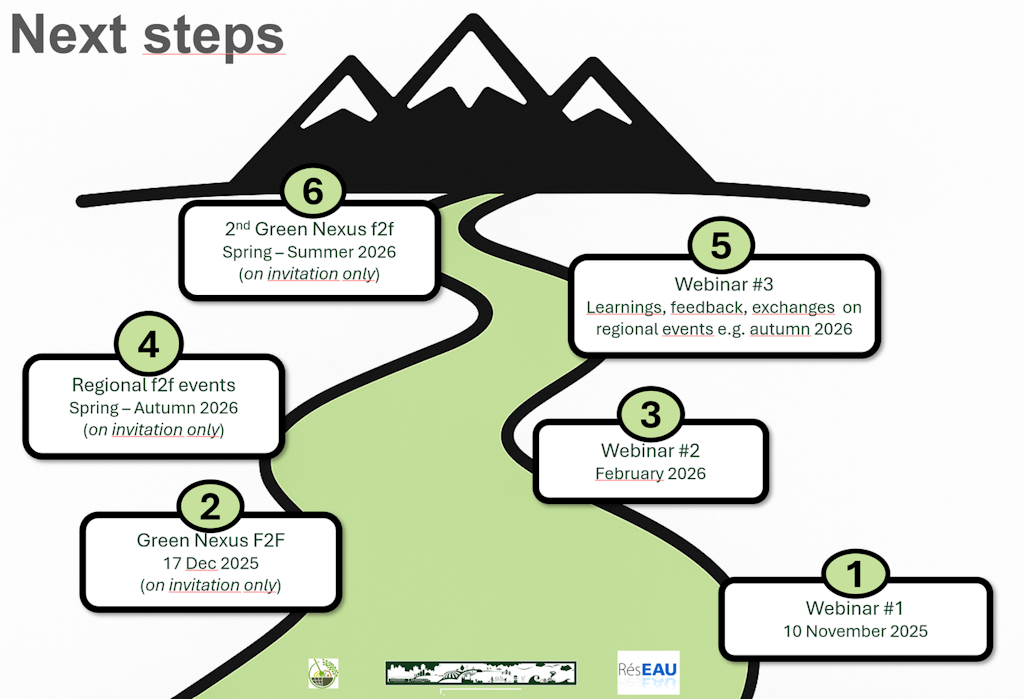
If participants left the webinar with many ideas swimming in their heads, this was unsurprising. The aim of the “learning journey” is to coalesce those ideas in the coming weeks and months, into regional initiatives and concrete action. The next point on this journey is a in-person workshop (on invitation) in Bern on 17 December. An overview of the foreseen steps of this journey can be found below.
Recording
Keynote speech – Global context & polycrises
Clara Nicolai, Potsdam Institute for Climate Impact Research (PIK)